
It’s Never Just Fine Motor: What’s Really Behind Your Preschooler’s Pencil Struggles
Does your three-, four-, or five-year-old dodge the coloring table, grip crayons in a tight fist, or melt down the minute a worksheet comes out? Maybe a teacher mentioned "fine motor" at pickup and sent home a list of tweezer activities. Those can help! But after years of working with little ones here in Philly, I can tell you that handwriting concerns are never just about fine motor. The hand is the last stop on a long chain that starts in the core, runs through the shoulder, and depends on the eyes, the senses, and a nervous system that feels calm enough to sit and try.
That's why I love meeting families in the preschool and pre-K years, before "real" handwriting is even on the table. Pre-writing skills (drawing lines, circles, and crosses, coloring, snipping) sit on foundations that are so much easier, and more fun, to build at three or four than to untangle once a tight, tiring grip is a habit in first grade.
What's Underneath the Pencil
Here's what we're actually thinking about when a child struggles with a crayon, plus a playful way to support each piece at home:
- Core and shoulder stability. Precise finger movements need a steady base, and a child who slumps or props their head on one hand is often working hard just to stay upright. Animal walks (bear walks up a grassy hill in Fairmount Park, crab walks, wheelbarrow races down the hallway) build that base. If your little one also trips a lot, our post on when a clumsy toddler might need OT or PT is worth a read.
- Bilateral coordination. Writing is a two-handed job: one hand writes while the "helper hand" holds the paper steady. Tearing paper into strips for a collage, opening containers, and rolling playdough snakes with both hands all practice that teamwork.
- Crossing midline. The midline is the imaginary line down the center of the body. Kids who avoid crossing it may switch hands halfway across the page, turn the paper, or scoot their whole body over instead of reaching, and hand dominance may be slow to settle. Some back-and-forth is typical in younger preschoolers, but if it continues as kindergarten gets close, it deserves a look. Try big lazy 8s (a sideways figure 8) on an easel, "windshield wipers" with a scarf in each hand sweeping across the body, and cross-crawl marching where each hand taps the opposite knee.
- Retained primitive reflexes. Babies are born with automatic movement patterns that usually fade as the brain matures, and when some linger, they can be one piece we look at. The ATNR (asymmetrical tonic neck reflex) links turning the head with straightening the arm on that side, so it can make crossing midline, or turning to look at the paper while writing, feel harder. The STNR (symmetrical tonic neck reflex) can make sitting upright at a table tiring, so kids slide down or sit on their feet. A lingering palmar grasp reflex can show up as a tight, fisted grip, and an active Moro (startle) reflex can keep the body on high alert, which makes settling in to focus harder. This isn't a diagnosis, just a lens. Crawling through a couch-cushion tunnel, "Superman" flying on the tummy, and rocking on hands and knees are simple ways to get kids moving through these patterns. We've written more about primitive reflex integration in occupational therapy.
- Visual-motor and visual-perceptual skills. Visual-motor skills connect what the eyes see with what the hand does, and visual-perceptual skills help a child make sense of shapes and space. Mazes, dot-to-dots, and copying a block tower you built all count.
- Proprioception and grip pressure. Proprioception is the body's sense of where it is and how much force it's using. Kids who snap crayons or barely make a mark are often still figuring this out. Heavy work like carrying groceries, pushing a laundry basket, or squeezing and pounding playdough helps, and our post on proprioception, the "secret sense" explains why.
- Sensory processing. Some children are bothered by the feel of chalk or the noise of a busy classroom, while others crave so much movement that sitting still is its own challenge. Messy play (shaving cream on the bathtub wall, finger painting) is a low-pressure way to explore.
- Attention and regulation. A child can have every skill and still fall apart at the table if their nervous system isn't ready. A movement break first, then short, successful tries, beats a long sit every time.
- Motor planning. Motor planning (also called praxis) is figuring out, sequencing, and carrying out a new movement. These kids often struggle to learn how to form a shape, even after watching you a dozen times. Obstacle courses and Simon Says are great practice.
- Hand strength. Yes, the hand matters too! Tearing paper, squeezing a spray bottle to water plants, and using a hole punch all strengthen the small muscles that hold a crayon steady.
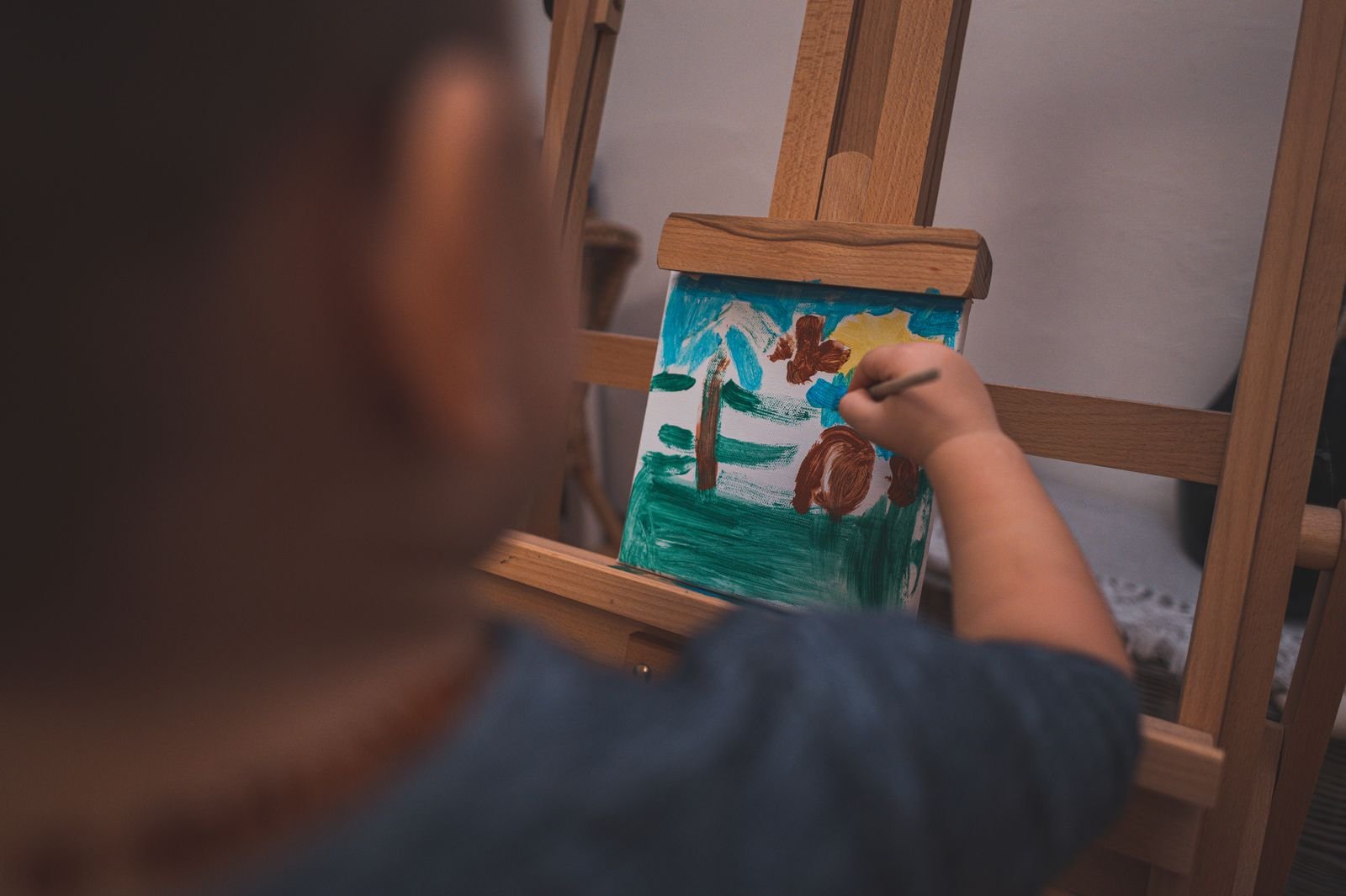
One more tip I give almost every family: go vertical! An easel, paper taped to the wall, or a chalk mural on the side of your Fishtown rowhome naturally puts the wrist in a good position while working the shoulder and core.
Signs Worth a Closer Look
One of these on its own is often just being three. If you're seeing several, or table time has become a battle, it's worth checking in:
- Avoiding coloring, drawing, puzzles, or crafts, or saying "I can't" before trying
- A fisted or constantly changing grip, or complaints that their hand is tired
- Pressing so hard crayons snap, or so lightly the marks are hard to see
- Switching hands mid-task, or no clear hand preference as kindergarten approaches
- Trouble copying simple shapes like a line, circle, or cross
- Slumping, lying on the table, sitting on their feet, or sliding off the chair during table work
- Frustration with scissors, buttons, or zippers
Curious whether any of this sounds like your child's table time?
How OT Looks at the Whole Child
When we evaluate pre-writing and handwriting skills, we don't just hand your child a pencil and score the result. Our occupational therapists do a functional assessment. We watch how your child climbs, crawls, and plays, check posture and shoulder stability, look for lingering reflexes, and notice how visual-motor skills, sensory processing, and regulation hold up when a task gets hard. Then, yes, we look at grip and drawing too! The goal is to find where the chain breaks down, so therapy targets the real foundation instead of drilling letters. Sessions are play-based (think swings, obstacle courses, easel painting, and playdough), because that's how little bodies learn best, and families leave with simple everyday ideas, not a stack of worksheets.
Why the Preschool Years (and Daytime Sessions) Work So Well
Preschool and pre-K really are the sweet spot: foundations are still forming, habits aren't locked in, and kids this age are thrilled to crawl through tunnels. If your little one is home with you, with a nanny, or in a part-day program, daytime sessions can be a great fit too. Mornings and midday tend to catch preschoolers with more in the tank than the late-afternoon slump, and we'd love to see you at our Fishtown, Fairmount, or Wyndmoor offices.
Wondering if an OT evaluation is the right next step?
If your child's grip or table time has been nagging at you, trust that instinct. You don't need it all figured out before reaching out. Here at B.well tots, we offer a free 15-minute virtual consult so you can talk through what you're seeing with one of our providers and decide together whether an OT evaluation makes sense. Request yours at bwelltots.com/consult. We'd love to meet you and your little artist!
This post is for educational purposes and isn't a substitute for individualized medical advice.